Some kind of nostalgia permeates Natasha Juliano’s “The Grid” series, but it is a bit of an adventure to pin down at first.
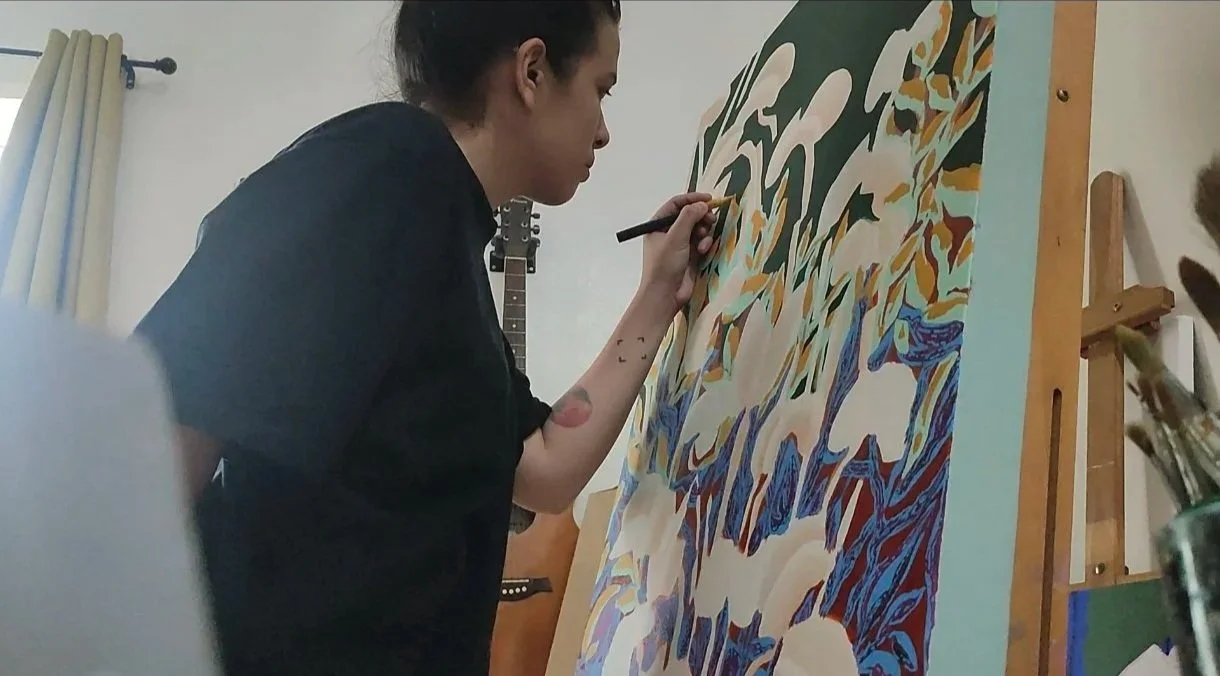
From a personal memory — doodling on the strict lines and boxes in her mathematics notebooks — drawing freely overcame the strict lines and boxes. Around the same time perhaps, growing up with her grandmother — a biology teacher and plant lady, inspired in her a desire to raise plants. The innate rawness of flora took hold, creating a fusion of organic and mechanical imagery — body parts, plant parts, flowers. At some point, the composition echoes art nouveau, which is in itself a crossroads of the organic and the applied.
Juliano shares, “This series of paper works continues my exploration of visual density through florals placed against checkered, grid-like backgrounds. Some parts of the flowers are zoomed in, while others feel like still-life arrangements, allowing the eye to move between small details and the whole image.”
In her process, the florals come first, and then the grid comes in and breaks down the image to create new ones, much like the Large Hadron Collider at CERN, Switzerland, opening up a different view of the subatomic: “It divides the surface into small sections, making each detail stand on its own while still being part of a larger, crowded image,” she adds. “The combination of organic forms and straight lines creates a push and pull between structure and chaos.” That sounds like the universe at work.
Since we’re on the topic of “parts of the whole,” the artist’s recent works at Tayo Tayo: Ugnayan, an Inter-space Group Exhibition, and at Thumbnail Gallery also bear this “breaking down” of the image. For the artist, this allows detaisl to come out and be seen, to be laid bare in front of the naked eye. This is a previously undiscovered comfort for her.
Grids are somewhat like that half-glass conundrum: is it half-full or half empty? but thinking of it as whether the grid makes lines or squares. The distinct palette of her works are guided by both randomness and uncertainty, but at the same time strategy and elements of a system — one that straddles her exercises in visual density. Juliano dissects it and finds that it is not merely “aesthetic,” but a push and pull: the vertical and horizontal lines hold the shape together, but also allows it to shift: a stable instability of sorts. The lines and squares constantly forming, unforming, and reforming into grids half-full or half-empty.
Written by Francisco Jin Sung Lee | Koki Lxx
Writer | Artist | Curator
