
Devoid of color, yet brimming with a spectrum both brazen and incognito. Kevin Roque’s works map, or rather, outline various ideologies and schools of thoughts through a variety of processes, from drawing — tracing a line, collage — cutting the edges, video and digital work — tracing data and the image. Together these edges wrap around and form the bigger picture — one that plays out social truths — harsh and unimaginable yet palpable and tangible, to personal histories, taut and precious.
Considering elements from the past as spectral beings weaving in and out and in between time, Roque deconstructs the colonial by building up what's “hidden, overlooked, or erased” into its own future form. Here’s a dive into some of the works:
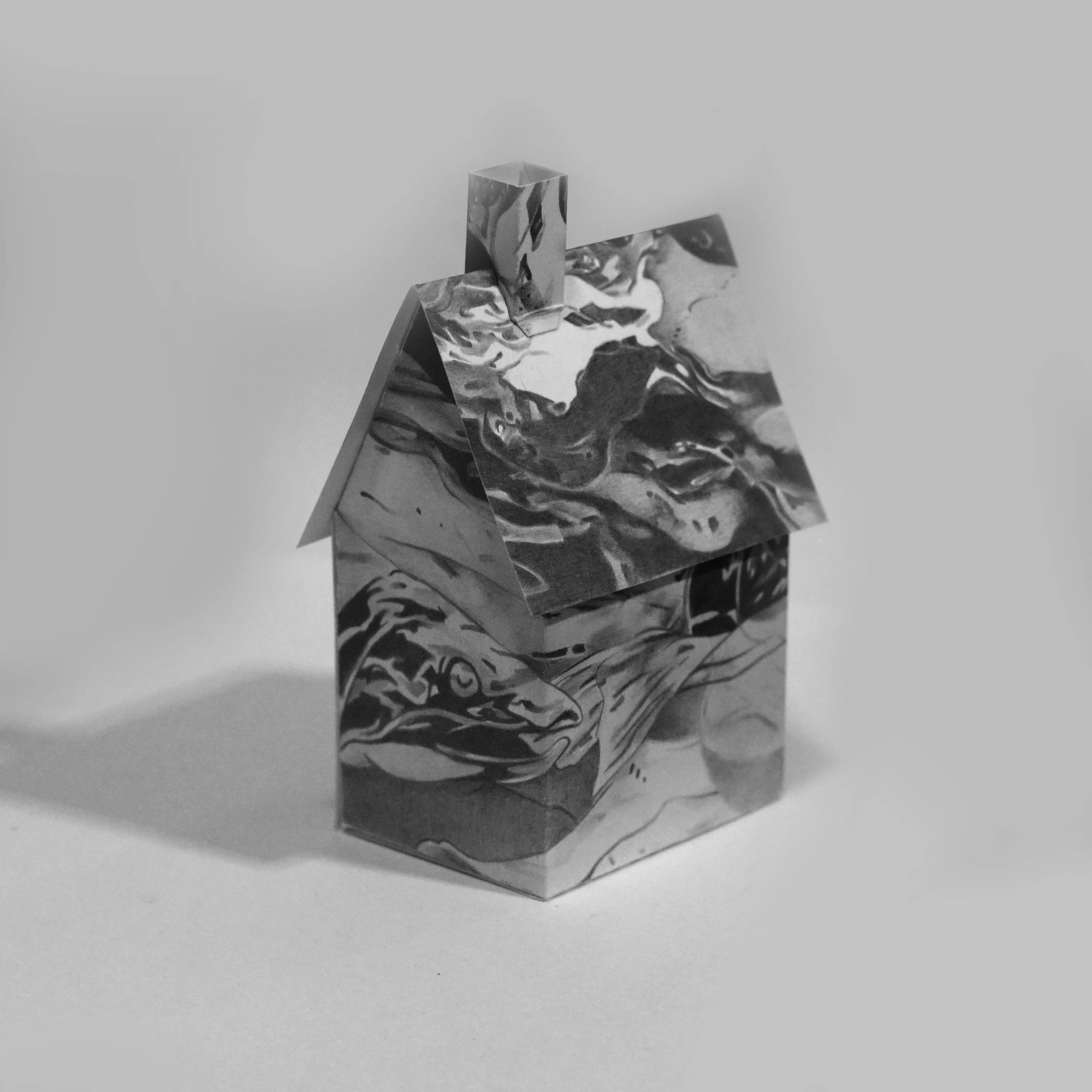
Graphite on paper sculptures
2023
Kevin Roque
Artist Statement:
The paper sculptures are a play on the Tagalog word 'tahanan,' which means home. It originates from the root word 'tahan,' which means to stop crying. Home is our safe space for expressing our emotions as well as for consolation.
In Manumbalik, a poignant yet striking image elegantly illustrates the artist’s experiences. The somber palette — seen throughout his oeuvre — highlights a delicately rendered subject, which on its face is somewhat unconventional (feet in Thai culture entails negative notions, being the dirtiest part of the body which touches the ground). His treatment gives it a presence, it entices the viewer to come closer and to inspect. At the same time, it gives off an eerie atmosphere, which is “grounded” in the fragility of human existence.
Inspired by the iconic jacket, Sukajan (derived from “Yokosuka Jumper”) is more recently known as a souvenir, and is not necessarily found in the wardrobes of Japanese. But it is that which extends its meaning-making to the artist, whose parents had been OFWs in Japan and the USA. Layered embroideries, silk and tapestry are juxtaposed with a paper plane — folded to bring it from the two-dimensional to the three-dimensional plane. What is history but lives layered over, melding in some parts so the elements become indistinguishable from the original — making identity both familiar and alien.
Even in its repetitive imagery, Splayed Figures somewhat echo Philippine Modernist works, perhaps H.R. Ocampo’s linework thrown into the festivities in Carlos “Botong” Francisco, Anita Magsaysay-Ho, or even Malang perhaps. As contemporary as Roque’s approach is, seeing glimpses of the Philippine Artistic tradition is a welcome touch. That the work is directly informed by shared tradition and culture among the Austronesian diaspora gives it more gravitas.
One thing that some historians point out in celebrating Independence Day on June 12 instead of July 4, is that events after 1898 and 1946 become flattened into some kind of “non-history,” where American actions in the Philippines become largely glossed over and ignored. One of the major events here is Dean Worcester’s photographic devolution of the Filipino by decades, if not centuries, framing the local as backward, uneducated, unsanitary, among others — at a time when the Filipino people already produced global figures such as Jose Rizal and Juan Luna. Adding insult to injury was the St. Louis Exposition of 1904 where indigenous Filipinos with millennia of history were presented as uncivilized tribes. Certainly it can be seen as a glitch, an Aberya, in Philippine history and identity. Roque subverts these photographs through collage which visually unearths the glitch, embracing the idea of error as resistance and revealing the malice in colonial stereotypes.
Other works include The Dispossessed, Politeismo, Aparisyon, Delubyo, Ancestors, Kuyog, Palestine, and Tahanan collectively “explore limits and translations into time, space, and reproducible digital images,” where the artist “opens up alternative realities shaped by local histories and cultural practices.”
Applying W.J.T. Mitchell’s “The Work of Art in the Age of Cybernetic Reproduction” — which is already an expansion of Walter Benjamin’s 1936 theory “The Work of Art in the Age of Mechanical Reproduction,” Kevin Roque furthers the idea of constantly evolving data processes found in the digital, in artificial intelligence, in video games, imbuing code with spiritual interventions as experiments in resonance with contemporary life. By making the reproducible authentic, one could say it is an attempt to bring aura (spirit?) back into art. One look at the works and you might agree.
Written by Francisco Jin Sung Lee | Koki Lxx
Writer | Artist | Curator
