
Looking at her body off work thus far, Jessa Almirol's trajectory from solitude to society is pretty evident. As she finds that every journey begins, and can only move forward, by first creating a safe space within.
From her Päntsdrunk series that explores state of mind and being in one's own spiritual plane, to the Sunday Blah series which focuses on the notion of simply existing or just living, or her Great Speck series which pivots to learning how to coexist, one can observe the body as an object transition from being isolated to being located, from being the singular subject depicted to a "zooming out" and revealing a greater, more monumental background. Onwards to the Sun Dance series which highlights how we are a part of something larger, where structures separate from the body appear, distant; then into the Mushin no Shin series, referencing a philosophy about allowing the universe to reveal a clearer path, that eventually transitions into the Summertime series, an act recognizing our shared belonging, which in turn matures into the Nesting series, a nod to how we all evolve. Somehow it seems that the inception of a new series seems a little too many, too fast – but one has just to understand that they are all valid expressions stemming from a constantly evolving place.
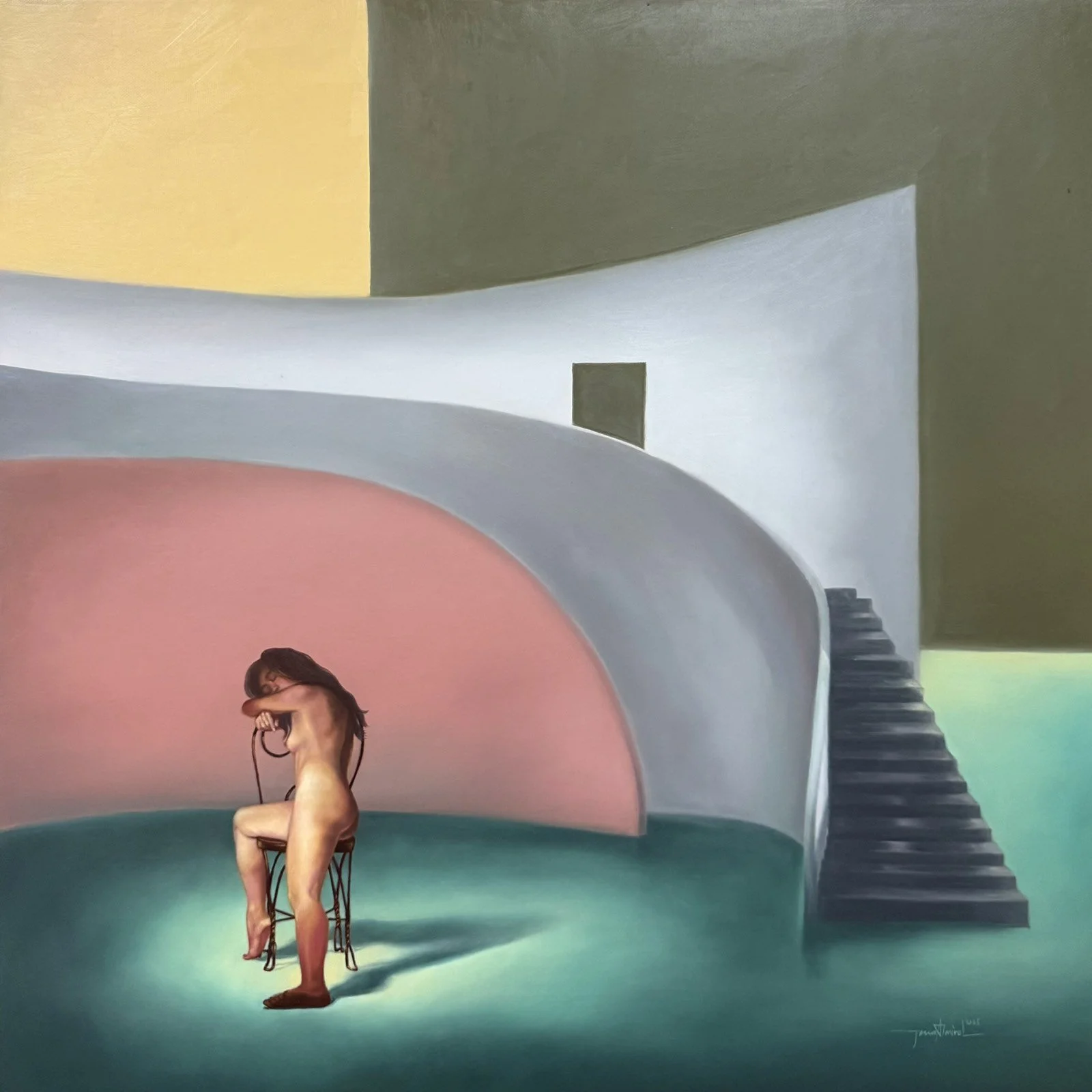
Let's focus on a particular series, Mushin no Shin (無心の心). Almirol herself is trained in the Western tradition of painting, and such is her occupation as an art teacher, but what manifests regardless, is a personal resonance, let's say an "Asianness," so to speak. While certainly Japanese, Mushin no Shin is a concept that is centrally Buddhist. Interestingly, the character for "empty" is a complex one, with about 14 strokes, whereas "mind" has only 4, or for those who dabble in calligraphy, 3. The "empty mind mind" is a prevalent concept in the Zen school of Buddhism, which also straddles such disciplines as gardens, walking, and the tea ceremony.
The tea ceremony specifically, is a deceptively simple complexity, one that takes decades to master, but in reality takes a lifetime to learn. In this discipline – every item, every action is deliberate and measured, yet a free and considerate motion. One of the main aspects of the ceremony is the tea room architecture, and central to it is the tokonoma, usually translated as an alcove. It is a recess in a wall of a tea room, where a focal point, a pondering, is placed for the participants of the ceremony. An ikebana arrangement, an unfinished sculpture, a profound scroll. A small detail that makes the viewer rethink their place in the cosmos: a wisdom that is accidental and fated.
That image reflects Almirol's painting composition and subject matter. An empty space that frames a singular object of contemplation – a naked body against a vast desert. One detail that exists in all of the paintings, regardless of series, are shadows. Tanizaki Junichiro in his essay "In Praise of Shadows" describes and defines the inherent value placed in thoughtful design throughout Asian architecture, particularly used in Japanese houses. Whereas Western architecture uses a lot of clear windows and lighting, the Japanese intentionally utilise the absence thereof for how it brings out the natural, organic beauty in human forms, shaped by shadows.
Almirol has traversed a growth outwards, seen in the series "All Tribes are from Fire" where she expounds on our singular origin as inhabitants of the same planet (alone in the universe as far as our limited knowledge can prove). The fire creates nuanced variations of the figures, shadows defining and redefining each moment. We come to her latest, “Village Without Villagers,” which examines the relationship between humans and society, the stones and the buildings. What does it mean to belong without discomfort? Whose needs are more important, that of the many, the few, or the one?
Seeing the value in humanity as vessels, of learning, of living, of existing, situated in the vast universe of open space, Jessa Almirol is showing us that each of the many is a unique person that is part of the bigger picture, and that bigger picture will never exist without each singular person.
Written by Francisco Jin Sung Lee | Koki Lxx
Writer | Artist | Curator
